
car emblems may look small, but a poor fit can leave a visible gap on a vehicle’s grille, tailgate, or steering wheel. Global buyers also face different model years, climates, shipping routes, and supplier standards. The scale is substantial: the International Organization of Motor Vehicle Manufacturers (OICA) reported approximately 93.5 million vehicles produced worldwide in 2023. That figure does not measure emblem demand, but it shows why buyers need clear specifications across diverse markets. Details matter.
A careful purchase starts with vehicle compatibility, dimensions, mounting style, material, finish, and sample checks. Ask suppliers for measured drawings, adhesive or fastening details, packaging protection, and written quality criteria. Photos are not proof. OICA’s production data provides useful industry context, while direct sample inspections help assess the actual product. For branded designs, verify authorization and confirm that the supplier can document it. This protects buyers from costly confusion and supports responsible sourcing. Weather exposure matters, too: a badge fitted to a humid coastal vehicle may need different durability checks from one used in a dry inland climate. Yet product listings often omit these details. Buyers should ask, then record the answers. This guide presents ten practical buying tips for comparing suppliers, checking samples, and planning orders with fewer surprises. Some questions may feel repetitive. They are still worth asking.
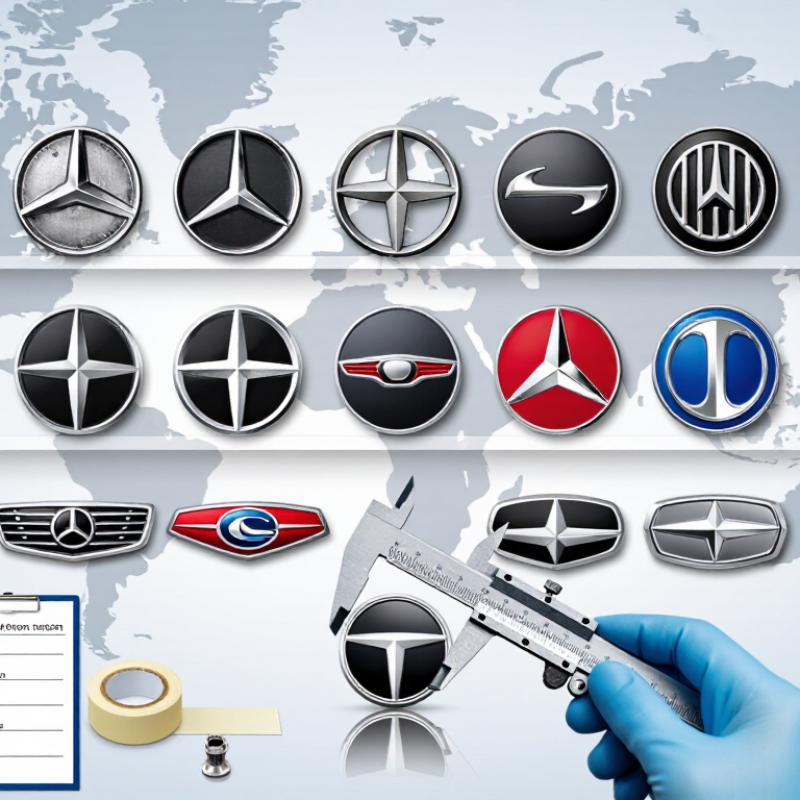
OICA’s 2023 production statistics recorded approximately 93.5 million motor vehicles built worldwide. That figure describes production, not the number of vehicles on the road, but it signals the scale and variety buyers must consider. Emblems differ by vehicle generation, trim, and mounting location, even when they look nearly identical in a product photo. A grille badge may use locating pins, while a rear emblem may rely on adhesive over a curved panel. Small details matter. Before ordering, match the emblem’s dimensions, pin spacing, curvature, and attachment method against the original part or a clear vehicle-specific drawing.
Define the emblem type before comparing suppliers: exterior nameplate, grille emblem, wheel-center cap, or interior badge. Then confirm fitment using the vehicle’s model year, body style, and exact mounting position. OICA’s global production total should not be treated as evidence that one design fits many vehicles. It points to a diverse market, not universal compatibility. Ask for measured drawings and close-up photos of the back, including clips and adhesive areas. Check material and finish consistency across samples; slight color variation can stand out under direct sunlight. A universal-fit claim is tempting, but it deserves scrutiny. Even careful measurements can miss panel curvature, so a test fitting remains useful.
A car emblem faces more than rain. Road spray carries grit and salt into its edges, while sunlight can fade exposed finishes. ISO 20653:2023 defines IP protection codes for electrical equipment in road vehicles; it is useful context, but it does not certify every decorative emblem. Check what the supplier actually tested. Small distinction, big difference.
Ask for the test method, sample condition, and result—not just “waterproof.” ISO 20653 includes high-pressure water testing, with IPX9K describing protection under specified hot-water jet conditions. That rating does not prove resistance to years of UV exposure, temperature cycling, or adhesive failure. Look for separate weathering and adhesion results, such as documented exposure under ISO 4892-2 or a relevant automotive test procedure. A glossy surface can hide a weak bond.
Inspect the back and perimeter of a sample. A narrow gap around a raised letter can trap moisture; a sharp edge may lift after repeated washing. Ask whether testing used the complete emblem, including its adhesive and substrate, rather than a bare housing. Compare the report’s test conditions with the vehicle’s actual use. The match may not be perfect. That uncertainty deserves a clear answer, not a larger IP number.
Check Material and Weatherproofing Against ISO 20653 Road-Vehicle IP Codes
The bars show the water-protection code numeral, not a direct measure of test severity. In ISO 20653, “X” means no dust-protection rating is specified; “K” marks a specific automotive test designation. For an emblem, ask suppliers for the exact IP code and test evidence for the assembled part, including its materials, seals, mounting, and intended exposure. IPX8 conditions are agreed for the test and should be checked in the relevant documentation.
Code descriptions are summarized; consult the applicable edition of ISO 20653 for test conditions.
10 Car Emblem Buying Tips for Global Buyers
Assess Supplier Quality Systems Using IATF 16949:2016
For car emblems, consistent fit and finish depend on controlled processes, not just attractive samples. IATF 16949:2016 provides a useful framework for assessing an automotive supplier’s quality management system. Check that the certificate is current and covers the actual production site and relevant manufacturing scope. A certificate alone cannot confirm that every emblem will meet your requirements. Not proof by itself.
Tips: Ask how the supplier controls incoming materials, tooling changes, and production defects. Request sample inspection records, corrective-action examples, and traceability details for a recent batch. Compare those records with the emblem specification, including dimensions, coating, color, and attachment method. If possible, review the production area and observe how operators identify and isolate nonconforming parts.
Look for evidence that quality checks happen during production, not only before shipment. Ask how measurement tools are calibrated and how recurring defects are reviewed. A practical supplier should explain the process clearly and provide records that match what you see on the floor. One point is easy to overlook: paperwork can be complete while a small process weakness remains. Discuss risks openly, agree on acceptance criteria, and document responsibilities before placing a large order.
| Tip | What to Assess | Evidence to Request | Buyer Action |
|---|---|---|---|
| 1. Verify IATF 16949 certification | Confirm that the certificate is current and covers the actual manufacturing site and relevant production activities. Certification applies to a defined scope, not automatically to every site or product of a supplier. | A current certificate showing the site address, scope, certificate status, and issuing certification body. | Check certificate details with the issuing certification body. Treat certification as evidence of a quality management system, not a guarantee that every part will be defect-free. |
| 2. Check the quality system’s relevance | Determine whether the supplier’s controlled processes cover the emblem’s actual manufacturing route, such as forming, molding, finishing, coating, printing, or assembly, as applicable. | Process flow, quality manual or system overview, internal audit results, and applicable process-control records. | Compare the documented scope and process flow with the proposed production site and the quotation. |
| 3. Agree on product specifications before ordering | Define the emblem’s dimensions, shape, material, color, finish, attachment method, allowable variation, and inspection criteria. Performance requirements depend on the intended vehicle application and customer specifications. | Approved drawings, material specifications, finish requirements, inspection plan, and documented revision level. | Resolve unclear or conflicting requirements in writing before sample approval or production release. |
| 4. Review risk analysis and process controls | Check how the supplier identifies and controls risks such as dimensional variation, surface defects, color inconsistency, poor adhesion, or incorrect assembly. | Relevant process risk analysis, control plans, work instructions, inspection records, and reaction plans for out-of-spec results. | Confirm that controls address the agreed product requirements and that operators know what to do when results fall outside limits. |
| 5. Evaluate materials and surface finishes | Assess whether the selected substrate, coating, plating, paint, or decorative film suits the intended environment and customer-defined durability requirements. | Material declarations, supplier specifications, lot records, and test reports using agreed methods and acceptance criteria. | Specify the required tests and conditions with the customer or design authority; do not assume one test program applies to every vehicle application. |
| 6. Confirm sample approval and change control | Make sure samples represent the intended production process and that changes to materials, tooling, processes, or production location are controlled. | Approved sample records, revision history, change notification procedure, and customer approval records where required. | Document the approval criteria and require advance notification and appropriate approval for changes that could affect fit, finish, function, or compliance. |
| 7. Check traceability and nonconformance handling | Assess whether affected production lots can be identified and whether defective or suspect material is contained and investigated. | Lot identification rules, production and inspection records, nonconformance reports, containment procedures, and corrective-action examples. | Agree on the information needed to trace shipments and define timely escalation contacts for quality issues. |
| 8. Assess capacity and supply continuity | Determine whether equipment, staffing, tooling, and key material sources can support forecast demand and recover from foreseeable disruptions. | Capacity assumptions, production planning approach, maintenance records, and applicable business-continuity or contingency plans. | Share realistic forecasts and lead-time expectations, and discuss how the supplier will communicate shortages or interruptions. |
| 9. Review packaging and international shipment controls | Check that packaging protects the emblem’s surface and attachment features during handling and transport, and that shipment documents match the destination requirements. | Packaging specifications, transport or handling instructions, sample-packaging approval, and agreed shipping-document requirements. | Test packaging for the intended distribution route and confirm import, labeling, and documentation requirements with qualified trade professionals. |
| 10. Clarify customer-specific requirements and performance reporting | IATF 16949 includes requirements for addressing applicable customer-specific requirements. Automotive submission or approval activities, such as PPAP, apply when required by the customer or agreed program. | A requirement matrix, agreed submission package, delivery and quality performance reports, and corrective-action records. | Identify the governing customer requirements, submission level, approval responsibilities, and ongoing reporting expectations before placing the order. |
Note: IATF 16949:2016 is an automotive quality management system standard. Confirm the current certificate status, applicable scope, customer-specific requirements, and product acceptance criteria for each sourcing program.
For a car emblem intended for EU markets, check each material against End-of-Life Vehicles (ELV) substance limits. The usual maximum concentration is 0.1% by weight for lead, mercury, and hexavalent chromium, and 0.01% for cadmium. These limits apply to homogeneous materials, not the emblem’s total weight. A metal backing, decorative coating, plastic insert, and adhesive may therefore need separate review.
Ask suppliers for material declarations that identify the emblem’s layers and substance levels. A general statement such as “compliant” leaves too much unclear. Keep the part number, material specification, and test records together. X-ray fluorescence screening can help flag certain metals, but it does not reliably establish chromium’s chemical form. Use an appropriate laboratory method when results or documentation raise questions. Small details matter.
Do not rely on appearance. A bright, smooth finish can still conceal a restricted substance beneath the surface. Confirm that reports match the production version, not just a sample with a similar look. Exemptions may apply to specific uses, but verify their scope and validity before relying on them. I would treat a supplier declaration as a starting point, not the final check.
Before ordering car emblems, compare the minimum order quantity with your actual sales plan. A low unit price can look attractive, yet a large MOQ may leave cartons sitting in storage. Ask whether the supplier can mix finishes or sizes within one order. Confirm the sample and production specifications match, including dimensions, adhesive backing, and surface finish. Small differences matter.
Incoterms define who arranges transport, insurance, and delivery responsibilities at agreed points. Compare quotes using the same named place and Incoterm; otherwise, prices may not be directly comparable. Request packaging details, too: individual protective sleeves, dividers, and sturdy cartons can prevent scratches during transit. Ask for carton dimensions, gross weight, and photos of a packed shipment. I may be overly cautious here.
Calculate landed cost, not just the quoted unit price. Include freight, insurance, import duties, taxes, customs brokerage, and delivery to your warehouse. These charges can vary with shipment size and destination, so confirm estimates with a qualified logistics or customs professional. Put each cost in a simple spreadsheet. Then compare the total per usable emblem, allowing for possible damage or rejects. One uncertainty remains: packaging that looks sufficient in a photo may fail a long, rough journey. Requesting a sample carton or clearer packing details can expose that risk before you place a larger order.