
Global buyers searching for China’s leading Eco Yoga Mat manufacturers need more than an attractive product photo. A mat may look clean and feel soft, yet still perform poorly after weeks of practice. Material choice, grip, cushioning, surface wear, and odor all matter. So does reliable production.
The term “eco” can describe different materials and manufacturing choices. Buyers should check whether a mat uses natural rubber, cork, recycled content, or another specified material. Ask for clear product data, relevant test reports, and details about coatings and adhesives. No label answers everything. A sample can reveal practical issues, including a slippery surface, uneven edges, or a strong smell that fades slowly.
China has manufacturers with varied capabilities, from established export factories to smaller specialists. Their experience, production scale, customization options, and quality controls can differ considerably. This guide introduces ten manufacturers for global buyers to assess, not as a substitute for due diligence. Compare specifications, request samples, and confirm lead times, packaging details, and communication practices before placing an order. Small details count.
An Eco Yoga Mat should suit the people who use it and the conditions in which it will be shipped and stored. One supplier may offer better grip, while another may provide more flexible branding or material options. The right choice depends on your market and priorities. Even a well-presented factory profile leaves questions worth asking.
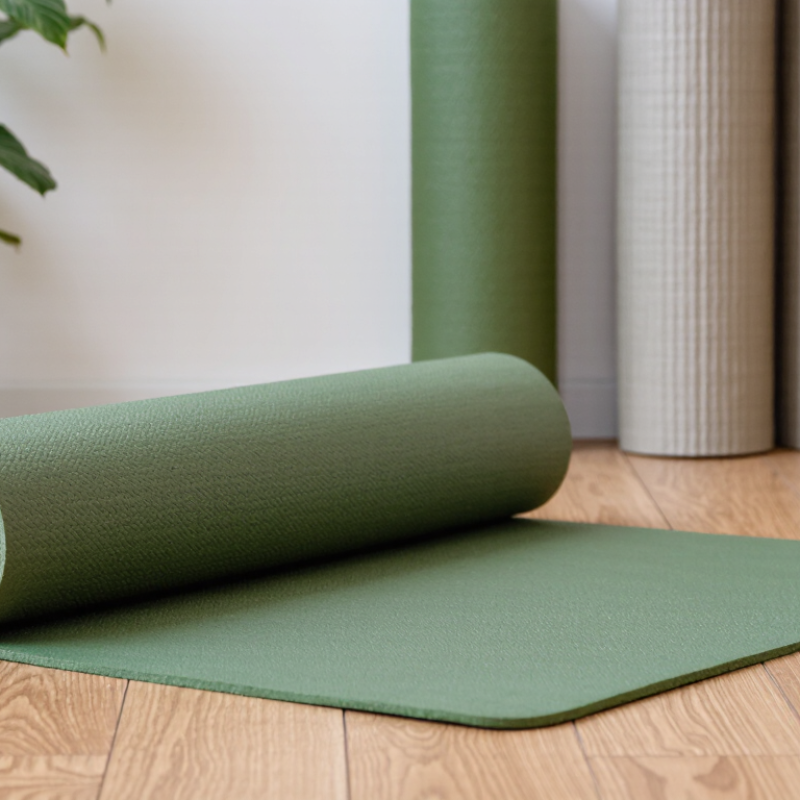
An eco-friendly yoga mat manufacturer in China should be able to explain what goes into each mat, not rely on broad claims. Ask for material specifications, recycled-content records, and details about any natural rubber, cork, or foam used. The word “natural” alone does not prove low impact. Request current test reports for relevant emissions and product safety, and check that they cover the exact material and product being quoted. Details matter.
Manufacturing practices count, too. Ask how the factory manages water, energy, scrap, and packaging, and whether these practices can be supported with records or an independent audit. A supplier’s certificate is useful only when its scope and validity are clear. Request a sample, then check its surface grip, odor, edge finish, and recovery after repeated rolling. No mat is impact-free. Recycled inputs can vary between batches, and a durable mat may be preferable to one that wears out quickly. Still, durability claims need testing, not just confident wording. A careful buyer should compare evidence with the finished product.
Eco yoga mats are not sustainable by label alone. For global buyers, material records and factory practices matter as much as surface feel. Natural rubber offers grip and elasticity, but sourcing and transport can affect its environmental impact. Cork can add texture, while recycled fibers may reduce demand for virgin materials. No material is perfect.
Tips: Ask for clear material specifications and details about recycled content. Check whether inks are water-based and production scraps are reused. Request information on odor, cleaning, and expected wear. Small details count.
Manufacturing choices also shape a mat’s footprint. Efficient cutting can limit offcuts, and careful curing can reduce defects. Some factories use lower-impact processes, but buyers should verify claims with supplier documentation rather than relying on broad terms like “green.” A mat that lasts through regular practice may avoid frequent replacement, though durability depends on its construction and care. I would still compare real wear samples; product sheets rarely show how a mat feels after months of use.
| Sourcing Profile | Mat Construction | Key Material | Common Production Method | Potential Sustainability Considerations | Buyer Verification Points |
|---|---|---|---|---|---|
| 01 — Natural rubber mat | Single-layer or laminated mat | Natural rubber, derived from rubber-tree latex | Rubber compounding, sheet forming, vulcanization, and surface texturing | Uses a renewable feedstock; natural rubber is not suitable for people with latex sensitivity and is not automatically biodegradable as a finished product. | Request material composition, latex-allergen information, and test reports for restricted substances. |
| 02 — Cork-and-rubber mat | Cork surface bonded to a rubber base | Cork veneer or cork-rubber composite with natural or synthetic rubber backing | Cork-sheet preparation, adhesive lamination, cutting, and edge finishing | Cork bark can be harvested without felling the tree; adhesives and backing materials affect the product’s overall environmental profile. | Confirm cork content, backing composition, adhesive type, and whether the layers can be separated for disposal. |
| 03 — Jute-and-rubber mat | Woven jute layer laminated to a resilient backing | Jute textile and rubber backing | Jute weaving, backing preparation, lamination, trimming, and finishing | Jute is a plant-based textile fiber; durability and end-of-life options depend on the backing and bonding materials. | Ask for fiber-content breakdown, backing details, seam or edge durability tests, and care instructions. |
| 04 — TPE foam mat | Lightweight, closed-cell foam mat | Thermoplastic elastomer (TPE) | Polymer compounding, extrusion or foaming, embossing, and die cutting | Some TPE formulations can be reprocessed, but recyclability depends on the exact formulation and available local collection systems. | Request the polymer specification, recycled-content evidence if claimed, and confirmation of applicable recycling routes. |
| 05 — Recycled-PET surface mat | Textile top layer bonded to a cushioning base | Recycled polyester (rPET) surface fabric with rubber, foam, or other backing | Fiber or yarn preparation, textile weaving, lamination, and cutting | Recycled PET can use post-consumer or post-industrial feedstock; a mixed-material construction may complicate recycling. | Verify recycled-content percentage and chain-of-custody documents; identify every layer and bonding agent. |
| 06 — Organic-cotton cover mat | Washable textile cover with a separate nonslip base or insert | Cotton fabric; organic status depends on certified supply-chain documentation | Fabric knitting or weaving, sewing, and assembly with a removable backing where applicable | A removable cover can simplify cleaning and replacement; organic claims require appropriate certification and scope checks. | Check the certificate holder, product scope, fiber composition, dye information, and washing durability. |
| 07 — Natural-rubber and cotton mat | Textile face laminated to a rubber base | Natural-rubber backing and cotton surface fabric | Textile preparation, adhesive or thermal lamination, vulcanization where applicable, and cutting | Combines plant-derived materials, but the adhesive, coatings, and multi-layer construction affect recyclability and disposal. | Request a layer-by-layer bill of materials, adhesive information, and bond-strength test results. |
| 08 — PVC-free foam mat | Flexible foam mat made without polyvinyl chloride (PVC) | Non-PVC polymer formulation, such as TPE or another disclosed foam material | Compounding, foaming, sheet forming, surface embossing, and cutting | “PVC-free” describes the absence of PVC, not overall environmental performance; assess the disclosed polymer and additives separately. | Obtain a written material declaration and independent test reports supporting PVC-free and restricted-substance claims. |
| 09 — Water-based-ink printed mat | Printed textile or coated mat surface | Base material varies; water-based inks may be used for the printed design | Surface preparation, screen or digital printing, curing, and final cutting | Water-based inks can reduce the use of certain solvent-based printing systems, but the full formulation and curing process should be reviewed. | Ask for ink safety data, print durability results, and confirmation that the claim applies to the actual production line. |
| 10 — Recycled-rubber-content mat | Rubber sheet or composite mat with declared recycled content | Recycled rubber blended with virgin rubber or other disclosed materials | Feedstock sorting and grinding, compounding, sheet forming, vulcanization, and trimming | Using recovered rubber can reduce demand for virgin feedstock; performance and chemical profile depend on the source and processing controls. | Verify recycled-content percentage, feedstock origin, batch traceability, odor and emissions tests, and restricted-substance compliance. |
| Buyer note: These are material and production-method profiles, not named or ranked companies. Material claims, certifications, recyclability, and environmental performance should be verified for the specific product, factory, and destination market. | |||||
For global buyers comparing China’s eco yoga mat manufacturers, evaluate evidence, not green wording. The Global Wellness Institute’s 2024 Global Wellness Economy Monitor valued the wellness economy at US$6.3 trillion in 2023 and projected US$9 trillion by 2028. That outlook signals opportunity, but it does not prove demand for any particular mat. Ask suppliers to identify each layer’s material and provide current, product-specific test reports. “Eco-friendly” alone tells you little.
Check whether claims about recycled content, natural rubber, or emissions match factory records and independent testing. The Textile Exchange’s 2024 Materials Market Report estimated global fiber production at 124 million tonnes in 2023, highlighting the scale of material sourcing; it is useful context, not proof that a mat is sustainable. Review chemical testing, batch traceability, and defect records. Request a sample, then inspect its grip, odor, edge finish, and thickness after repeated use. Small details matter.
A factory audit can reveal whether production capacity, worker training, and quality controls match the quotation. Compare lead times, minimum orders, packaging, and shipping terms in writing. Ask how material changes are approved between batches. Certificates can help, but they may cover only one product or process. I would still question broad claims when the supporting documents are vague. Manufacturers that answer precise questions clearly are easier to assess, even when their answers are not perfect.
Use these GOTS thresholds when evaluating textile components and supporting material claims. They are certification criteria, not manufacturer ratings.
GOTS requires at least 70% certified organic fibers for the “made with organic” label and at least 95% for the “organic” label. GOTS applies to textile products; it is not a universal certification for yoga mats or non-textile materials such as rubber.
Source: Global Organic Textile Standard (GOTS), labeling requirements.
China’s eco yoga mat sector includes factories with different material and production strengths. One profile focuses on natural rubber mats, often chosen for grip and dense cushioning. Another works with cork surfaces, pairing a textured top layer with a flexible backing. A third specializes in TPE mats, which are lightweight and easy to clean. A fourth combines cork and natural rubber for a firmer feel. A fifth produces recycled-material options, though buyers should ask how recycled content is verified.
The remaining profiles include a maker of thin travel mats, a factory offering custom dimensions, and a supplier focused on printed designs. Another profile emphasizes thicker mats for extra joint cushioning. The tenth serves buyers seeking mixed-material products and flexible order quantities. These are useful starting points, not guarantees of quality. Factory capabilities can change, and “eco” may describe different materials or processes. Request current specifications and samples before comparing suppliers.
Tips: Check grip when damp, mat thickness, odor, and packaging. Ask for material details and test a sample after repeated cleaning. Small checks matter. A supplier’s product sheet may leave questions unanswered, so confirm details in writing.
Export capability is more than a low quote. Ask suppliers for recent export references, production lead times, carton dimensions, and shipping documents. Confirm whether quoted prices cover samples, packaging, and inspection. Textile Exchange’s Materials Market Report 2024 estimates global fiber production reached 124 million tonnes in 2023, while recycled fibers made up 7.7%. This broader materials data is not specific to yoga mats, but it shows why buyers should verify recycled-content claims and request traceable material records. A certificate alone is not proof.
Customization should be tested on a physical sample. Check mat thickness, surface grip, odor, edge finish, and print alignment under ordinary use. Request written specifications for materials, dimensions, color tolerances, and packaging before approving production. Independent testing can help verify claims such as recycled content and product performance. Still, test results cover only the samples and conditions stated. That distinction is easy to miss.
Tips: Request a dated factory audit, a recent test report, and a sample from the same production line. Compare documents with the supplier’s legal business details. Ask who handles defects and replacement costs. Small details matter. If a supplier cannot explain a material claim clearly, pause and investigate further.