Buying Military Clothing across borders is not merely a matter of comparing fabric prices. Buyers must assess durability, fit, climate suitability, supplier capacity, and documented quality controls. A jacket that performs well in a sample room may feel different after repeated washing or long wear. Small details matter.
Industry reports offer useful context, but they are not procurement checklists. Textile Exchange’s Materials Market Report 2024 estimated global fiber production at 124 million tonnes in 2023, highlighting the scale and complexity of textile supply. The World Trade Organization’s April 2024 Global Trade Outlook and Statistics forecast merchandise trade volume growth of 2.6% in 2024 and 3.3% in 2025. These figures describe broad markets, not military clothing demand. Still, they underline why buyers should examine sourcing, lead times, and supply continuity rather than rely on a single quotation.
This guide presents ten practical checks for evaluating suppliers and products. It covers material specifications, sample testing, sizing consistency, traceability, production capacity, and clear contract terms. Buyers should also confirm that products meet their organization’s lawful requirements and intended use. Ask for evidence, not just promises. A checklist helps, but judgment still matters. Some decisions remain imperfect; recording the reason for each choice can help teams learn from later orders.
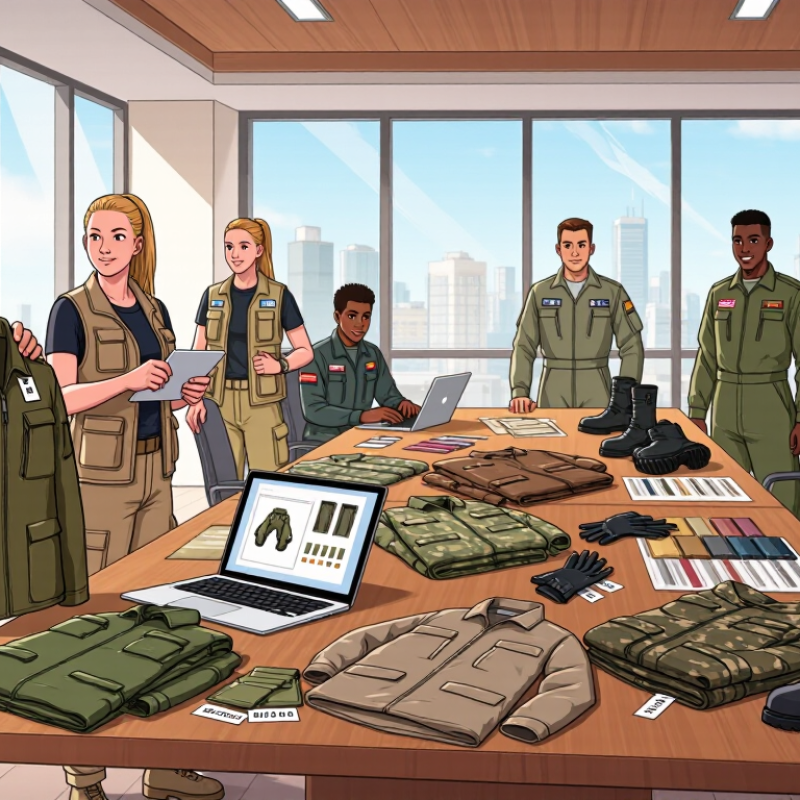
Before comparing fabrics or colors, translate the task into a written use profile. Record the activities, movement, and equipment the clothing must accommodate. Will wearers spend hours kneeling, climbing, or sitting in vehicles? Note whether pockets must remain reachable while carrying a pack. Details matter. These observations help buyers compare garments against actual work, rather than relying on appearance or a broad product description.
Climate requirements need specifics, too. A hot, humid environment calls for breathable layers that dry efficiently, while cold conditions may require space for insulation beneath an outer shell. Consider rain, wind, sun exposure, and daily temperature swings. A garment suitable for a warm afternoon may feel restrictive when layered on a cold morning. If possible, review fabric weight and construction, then test a sample in realistic conditions. Climate charts help, but they cannot capture every shift in weather.
End users should help define fit and function. Ask wearers about sleeve length, waist adjustment, ventilation, and comfort with protective equipment. Include different body shapes in fitting sessions; a size chart alone can miss real fit problems. A short wear trial can reveal chafing at the collar or a pocket that catches on a belt. One trial will not answer everything, and buyer assumptions deserve a second look. Collect specific feedback before confirming quantities.
Fabric choice should match the climate and workload, not just the product description. Cotton blends can feel comfortable in warm conditions, while synthetic fibers often dry faster after rain. Ask for the fabric weight and composition, then compare swatches if possible. Feel the difference. A stiff sample may soften with washing, but it can also restrict movement.
Construction details reveal how well a garment may hold up. Check seam consistency, bar tacks at pocket corners, and closures that remain easy to operate with gloves. Pull gently on high-stress areas, such as knees and elbows. Loose threads are a warning, though one imperfect stitch does not prove poor overall quality. Heavier fabric is not always better; it may trap heat and add fatigue during long wear.
Sizing needs careful checking across suppliers. Compare actual garment measurements with a well-fitting item, rather than relying only on labels. Allow room for a base layer, but avoid excess fabric that catches or bunches. Fit is not vanity. Protective features also need evidence: request test documentation for claimed resistance to abrasion, weather, or heat, and confirm that it applies to the complete garment. A useful feature on paper may disappoint in daily use. Test samples through realistic movement and laundering before placing a large order.
Compare approximate fabric weights when evaluating garment durability and wearability. These ranges are indicative: actual weight varies with fiber blend, weave, and finish, and fabric weight alone does not determine protective performance.
Buying tip: Match fabric weight to the intended climate and activity, then check construction, sizing, and any required protective certifications separately.
Global buyers should verify a supplier’s experience with garments similar to their intended order. Ask for production timelines, fabric specifications, and examples of quality records. Check whether the supplier can explain how sizing, stitching, and color consistency are controlled. A polished catalog is not proof of reliable production. Request references where appropriate, and confirm that the information is current.
Tip: Request samples before approving bulk production. Examine seams, closures, labels, and fabric weight under ordinary handling. Wash a sample if the care instructions allow it, then check for shrinkage, fading, or twisted seams. Compare samples with the written specification, not just with photographs. Small differences matter.
Quality standards should be clear before an order is placed. Ask which inspection criteria and test methods the supplier uses, and request relevant reports for the specific fabric or garment. Confirm how defects are recorded and corrected. Keep approved samples and specifications for later comparison. One caution: a sample may not represent every production batch, so agree on inspection checks before shipment. Even experienced buyers can overlook a detail when schedules are tight. My own checklist would include measurements, seam strength, and shade consistency, though no checklist catches everything.
For military clothing, compliance starts with the exact product description, not the invoice label. Record fiber content, intended use, country of origin, and tariff classification before requesting a quote. Export controls may depend on destination, end user, and end use, so confirm requirements with the relevant authorities and the buyer’s customs broker. Do not assume a uniform is treated like ordinary apparel. Small differences matter.
Check the destination’s import permits, labeling language, origin rules, and required test reports. For protective garments, verify which performance standards apply; ISO 13688 sets general requirements for protective clothing, but it is not a universal military-clothing approval.
OECD analysis estimated that fully implementing the WTO Trade Facilitation Agreement could cut trade costs by an average of 14.3%.
UNCTAD’s Review of Maritime Transport 2023 reports that over 80% of world merchandise trade by volume moves by sea, where incomplete documents can delay shipments.
Keep copies of permits and certificates with the shipment file. Check them again before dispatch. A spreadsheet can still miss a country-specific rule; that is an uncomfortable, but useful, reminder to verify details with local authorities.
Before approving a military clothing order, request a line-item quote covering fabric, trims, testing, packaging, freight, and any inspection fees. Confirm the currency, quote validity, payment schedule, and what triggers a price change. A low unit price can hide costly exclusions. Ask for a dated production schedule, with sample approval, material arrival, inspection, and dispatch shown as separate milestones. Build in time for size or stitching corrections; estimates are not guarantees.
Tip: Put the agreed specifications and delivery milestones in writing. Request a pre-production sample, then confirm how changes affect cost and timing. UNCTAD’s Review of Maritime Transport 2024 notes that shipping carries over 80% of world trade by volume. For this reason, confirm the shipping method, named delivery point, cargo insurance, tracking, and who handles delays or damaged cartons.
Before paying a deposit, ask what after-sales support covers: defect reporting, replacement terms, response times, and access to spare buttons or matching fabric. Agree on photo evidence and a clear claim window. Keep one contact responsible for updates. A spreadsheet can still be wrong, especially when several sizes and colors are involved, so compare the final packing list with the approved order before dispatch. Ask for written confirmation of every correction.
| No. | Buying Tip | What to Confirm | Practical Buyer Action | Planning Consideration |
|---|---|---|---|---|
| 01 | Define the garment specification | Fabric composition and weight, color standard, construction, closures, pocket layout, labels, and permitted substitutions. | Provide a written specification and approved reference sample. Require written approval before any material or design change. | Incomplete specifications can lead to quote differences, rework, and inconsistent production lots. |
| 02 | Compare like-for-like pricing | Unit price, minimum order quantity, sample charges, tooling or setup fees, packaging, inspection costs, and quote validity. | Ask each supplier to quote the same quantities, sizes, material requirements, packing method, and delivery terms. | Request separate prices for samples, bulk production, and optional testing so the total landed cost is easier to assess. |
| 03 | Confirm production milestones | Sample approval, material procurement, production start, quality inspection, packing, and ready-to-ship dates. | Request a dated production schedule and ask which events could delay it, such as fabric availability or approval revisions. | Lead times vary by order size, material availability, season, and approval speed; obtain a project-specific schedule rather than relying on a general estimate. |
| 04 | Approve samples and size grading | Fit, measurements, grading rules, shrinkage allowance, color, workmanship, and labeling for every required size range. | Approve a pre-production sample and a measurement chart with defined tolerances before bulk cutting begins. | Allow time for sample review and corrections. Late changes may affect both cost and delivery dates. |
| 05 | Set measurable quality requirements | Inspection method, defect definitions, measurement tolerances, test requirements, and the process for handling rejected goods. | Agree on an inspection plan in writing and identify whether checks take place during production, before shipment, or at both stages. | Testing should match the garment’s intended use and applicable destination-market requirements; do not assume one test applies to every order. |
| 06 | Clarify payment terms and price changes | Deposit and balance milestones, accepted payment methods, currency, bank fees, cancellation terms, and rules for approved changes. | Put payment triggers and any conditions for price adjustments in the purchase contract or order confirmation. | Payment structures are negotiated and vary by supplier and order. Confirm the complete payment schedule before authorizing production. |
| 07 | Choose shipping terms and responsibilities | Named delivery point, export and import responsibilities, freight costs, insurance, customs clearance, and risk transfer. | State the agreed Incoterms® rule and named place in the sales contract, and confirm who arranges each transport and customs step. | Freight quotes depend on route, season, cargo volume, and service. Compare the full delivered cost, not freight price alone. |
| 08 | Build a realistic shipping buffer | Transport mode, transit estimate, booking lead time, port or airport handling, customs documentation, and contingency plans. | Ask for route-specific transit estimates and required documents. Work backward from the required arrival date and include time for clearance. | Transit estimates are not guaranteed delivery dates; congestion, weather, inspections, and local holidays can affect arrival. |
| 09 | Check regulatory and end-use requirements | Import restrictions, product labeling, textile rules, permits, sanctions screening, and any export-control requirements relevant to the goods and destination. | Confirm requirements with qualified customs or compliance professionals before placing the order, especially for controlled goods or restricted destinations. | Rules depend on the product, origin, destination, and end use. Obtain current guidance for each shipment rather than relying on assumptions. |
| 10 | Agree on after-sales support | How to report shortages or defects, evidence required, response time, remedy options, spare or replacement quantities, and warranty limits. | Record the claims process and remedy terms in writing, including the period for reporting issues after delivery. | Keep order records, approved samples, inspection results, packing lists, and delivery evidence to support any claim. |
Note: Timelines, costs, compliance obligations, and shipping arrangements are order- and route-specific. Confirm current details in writing before committing to a purchase.